
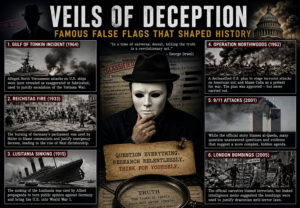
Veils of Deception: Famous False Flags That Shaped History

Written by Muhammad Mohsin Iqbal
It has been heard from the elders that a lie hath no legs to stand upon. Yet there come seasons when falsehoods are woven with such devilish art and patient cunning that truth herself seems but a pale shadow, faltering before the bold countenance of deception. Those lies which are not spun in the heat of passion but forged in the quiet chambers of calculation—to wound an adversary, to dress aggression in the robes of righteous vengeance, or to cast an enemy into the abyss of disgrace—are known in the English tongue as false flag operations. In our own Urdu idiom, it is as though one were throwing dust into the eyes of the beholder, blinding reason whilst the hand of mischief works its will unseen.
A false flag, at its core, is a deliberate act of harm or theatrical spectacle, contrived so that the true author remains veiled in shadow and blame descends upon another—be it a rival state, a restless faction, or some band of supposed fanatics. The purpose is seldom simple malice; rather, it seeks to kindle the fire of public indignation, to draw forth waves of sympathy for the apparent victim, and thereby to fashion a convenient pretext for retaliation, for open war, for the tightening of domestic fetters, or for the seizure of some long-coveted political advantage.
The term traces its lineage to the naval conflicts of the sixteenth century and earlier, when vessels of war would hoist the colours of a neutral nation or even those of their foe, drawing near in deceit before striking with their true identity revealed. In our modern epoch, the expression has broadened to encompass all manner of covert political and military stratagems—some now confessed in declassified archives, others lingering in the realm of fierce dispute, where official narratives collide with the testimonies of survivors, leaked papers, and the stubborn claims of geopolitics.
History, that stern chronicler, offers a grim gallery of such deceptions. In the autumn of 1939, Nazi Germany orchestrated the Gleiwitz incident with chilling precision. On the night of the thirty-first of August, operatives of the SS, led by Alfred Naujocks and clad in Polish uniforms, assaulted a German radio station in Upper Silesia. They broadcast a fabricated anti-German tirade in the Polish tongue, scattered evidence of sabotage, and left behind the body of a murdered German civilian dressed as a Polish agitator. This outrage formed part of the larger “Operation Himmler,” a series of staged border provocations. The very next morning, Adolf Hitler brandished it before the world as justification for the invasion of Poland, thereby unleashing the horrors of the Second World War upon Europe. Years later, at the Nuremberg Trials, the architects themselves admitted the plot—one of the most brazen and consequential false flags ever recorded.
A decade earlier, in 1931, officers of Japan’s Kwantung Army had employed a similar ruse near Mukden in Manchuria. A small explosion, scarcely damaging a section of the Japanese-owned South Manchuria Railway, was promptly blamed upon Chinese nationalists. The blast was trivial, yet it served as the spark for full-scale occupation. Within months, Japan had swallowed Manchuria whole and installed the puppet state of Manchukuo. The League of Nations, through its Lytton Report, discerned the fraud, but Tokyo scorned the verdict, withdrew from the League, and set Asia upon the road to wider conflict.
Nor has the Middle East been spared such shadows. In 1954, during the Lavon Affair—also styled Operation Susannah—Israeli military intelligence recruited Egyptian Jews to plant bombs in cinemas, libraries, and educational centres across Cairo and Alexandria. The design was to attribute the outrages to the Muslim Brotherhood, communists, or local nationalists, thereby undermining Egypt’s government and persuading Britain to retain its forces in the Suez Canal zone. The bombs were meant to detonate after closing hours to limit harm, yet one exploded prematurely. The conspiracy unravelled in arrests, executions, and suicides. Israel denied involvement at first, only to acknowledge the truth decades later. It stands today as a textbook case of a false flag that recoiled upon its makers and helped usher in the Suez Crisis of 1956.Even allies have found themselves ensnared in controversy.
On the eighth of June 1967, amid the heat of the Six-Day War, Israeli jets and torpedo boats launched a sustained assault upon the USS Liberty, an American signals intelligence vessel sailing in international waters off the Sinai Peninsula. The attack, lasting some seventy-five to ninety minutes, involved strafing runs with cannons, rockets, and napalm, followed by torpedo strikes that tore a gaping wound in the ship’s hull. Thirty-four Americans lost their lives—thirty-one sailors, two Marines, and one civilian—and 171 suffered wounds. Israel spoke swiftly of mistaken identity in the fog of battle; the United States, after several inquiries, accepted this account and received compensation. Yet many survivors and certain officers have long insisted the strike was deliberate, citing the ship’s clear markings, prior overflights by Israeli reconnaissance, and the Liberty’s mission to monitor Arab rather than Israeli communications. No formal confession of false flag intent has ever emerged, leaving the episode one of the most bitterly contested in American naval annals.
In our own Sub Continent, the pattern repeats with painful familiarity, often deepening the mistrust between neighbours. The Samjhauta Express bombings of February 2007 saw suitcase bombs tear through the coaches of the symbolic Friendship Train linking Delhi and Lahore. Sixty-eight souls perished, the majority Pakistani citizens returning home, with scores more injured. Early suspicion turned toward Pakistan-based militants, but India’s National Investigation Agency later traced the outrage to Hindu right-wing extremists associated with Abhinav Bharat. Confessions spoke of a motive of revenge— “bomb for bomb”—and a desire to sabotage peace efforts. Though charges were laid, a special court in 2019 acquitted the principal accused, citing insufficient evidence. Pakistan has repeatedly called for justice for its slain citizens, while the case lingers as a symbol of how blame may shift and victims may find no final closure.
The dreadful Mumbai attacks of November 2008 according to the Indian media, when allegedly ten Lashkar-e-Taiba gunmen from Pakistani soil wrought havoc across India’s commercial capital for nearly three days, killing more than 160 and wounding hundreds, remain etched in collective memory. Pakistan officially condemned the act, yet some voices have persisted in labelling it a false flag.
Even earlier, the 1971 hijacking of Indian Airlines Flight Ganga to Lahore by Kashmiri separatists provided India with grounds to ban Pakistani overflights at a moment of grave internal crisis for Pakistan. Later inquiries in Pakistan reportedly suggested Indian intelligence hands behind the episode, though India has always maintained it was a genuine militant action. Such claims and counter-claims have become threads in the enduring tapestry of suspicion.
Among these many instances, the tragedy at Pahalgam in April 2025 struck a particularly resonant chord for Pakistan. On the twenty-second of that month, armed gunmen emerged from the pine forests surrounding the serene Baisaran meadow near Pahalgam in Indian-administered Kashmir. The meadow, accessible only by foot or pony and long cherished by visitors as a slice of paradise, became a scene of horror as the attackers, bearing modern weapons and clad partly in military style, opened fire upon tourists enjoying the gentle slopes. Twenty-six civilians fell—twenty-five tourists and one local Kashmiri Muslim pony operator who heroically resisted—while some twenty others bore wounds. The assault, lasting several terrible minutes, shattered the peace of families and sightseers alike.
India attributed the massacre to Pakistan-based Lashkar-e-Taiba operatives and moved with aggressive measures. Pakistan’s leadership denounced the episode as an Indian-orchestrated false flag, crafted to legitimise fresh crackdowns in Kashmir, to escalate disputes over water, or to rally domestic opinion against Pakistan. In firm reply, Pakistan made plain that it had been “smelling a snake” for the past year and declared the incident a decisive turning point—one that sharpened its vigilance and resolve.
Whether the veil shall ever be wholly drawn from every such deception remains the verdict of time and honest inquiry. Some lies harden into the semblance of truth; others crumble when exposed to the light of evidence and conscience. Yet the ancient counsel of the elders holds firm; though falsehood may stride for a season upon borrowed legs, truth possesses a quiet, enduring strength. In the high affairs of nations no less than in the lives of ordinary men, wisdom demands that we pierce the dust cast before our eyes and resist the lure of letting passion sanctify deceit. Only thus may justice, however imperfectly, find its path through the shadows that so often cloud our troubled world.
Table of Contents
Read More :https://timelinenews.com.pk/lucky-irani-circus-the-ceasefire-in-islamabad/
In Urdu :https://dailytimeline.pk/