
Passive smoking and health consequences from tobacco.
Written by Syed Afnan Ali
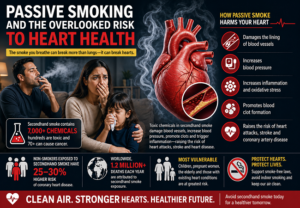
Many people assume that only smokers face serious health consequences from tobacco. Yet millions of non-smokers are regularly exposed to secondhand smoke, placing them at measurable cardiovascular risk. Passive smoking, the involuntary inhalation of smoke from burning tobacco products or smoke exhaled by smokers, remains a significant but often underestimated public health concern.
Secondhand smoke contains more than 7,000 chemicals, including hundreds that are toxic and dozens known to cause cancer. It arises from two primary sources: sidestream smoke from the burning tip of a cigarette and mainstream smoke exhaled by the smoker. When inhaled by non-smokers, these toxic particles enter the bloodstream and damage the lining of blood vessels, impairing normal cardiovascular function.
According to the Centers for Disease Control and Prevention, adults who do not smoke but are regularly exposed to secondhand smoke have a 25 to 30 percent higher risk of developing coronary heart disease compared with those not exposed. This elevated risk includes increased likelihood of heart attacks. Even short-term exposure has been shown to affect blood vessel function and increase inflammation, both of which are central mechanisms in cardiovascular disease development.
Globally, the burden is substantial. The World Health Organization estimates that more than 1.2 million deaths each year are attributable to secondhand smoke exposure. A significant portion of these deaths result from cardiovascular disease rather than cancer, underscoring the direct impact of passive smoke on the heart.
The situation is particularly concerning in countries where tobacco use remains common. In Pakistan, survey data indicate that more than one-third of adults report exposure to secondhand smoke. Both men and women are affected, reflecting the persistence of indoor smoking in homes, workplaces and public spaces. Given that heart disease is already among the leading causes of death in the country, widespread exposure to tobacco smoke compounds an existing health burden.
The biological link between secondhand smoke and heart disease is well established. Smoke exposure contributes to endothelial dysfunction, increases blood clotting tendency and promotes inflammation. These processes accelerate atherosclerosis and raise the probability of acute cardiac events. For individuals with pre-existing cardiovascular vulnerability, passive smoke can act as a trigger that exacerbates underlying risk.
Importantly, non-smokers do not need prolonged exposure to experience harm. Repeated exposure in enclosed environments such as homes, cars and poorly ventilated workplaces can cumulatively increase cardiovascular risk over time. Children, older adults and individuals with chronic conditions are particularly susceptible.
Reducing second hand smoke exposure therefore represents a critical component of cardiovascular prevention. Smoke-free public spaces, enforcement of indoor smoking bans and greater awareness about the risks of indoor smoking can significantly lower exposure levels. Protecting non-smokers is not simply a matter of personal comfort; it is a measurable public health intervention aimed at preventing heart disease and premature death.
However, enforcement alone may not fully address the problem in environments where smoking remains culturally embedded. A central reality of tobacco control is that the primary source of harm to passive smokers is not nicotine itself, but the combustion of tobacco. When cigarettes burn, they release thousands of toxic chemicals into surrounding air, directly affecting bystanders.
This distinction has prompted debate in several countries about the potential role of regulated smoke-free alternatives in reducing exposure to combustible smoke. While complete cessation remains the safest option, policymakers in some jurisdictions are examining whether shifting smokers away from burning tobacco products could reduce both active and passive harm, provided strict regulatory safeguards are in place and youth uptake is prevented.
For countries like Pakistan, where exposure levels remain high and cardiovascular disease already places heavy pressure on the health system, the policy question is no longer limited to warning labels and taxation. It also concerns whether comprehensive strategies can reduce public exposure to smoke itself. That requires political will, consistent enforcement of indoor smoking restrictions and careful evaluation of emerging regulatory frameworks that aim to minimise combustion-related harm.
Ultimately, the protection of non-smokers must remain central to tobacco control policy. Reducing the presence of combustible smoke in shared spaces, whether through stronger enforcement, cultural shifts or regulated transitions away from burning tobacco, represents one of the clearest pathways to lowering cardiovascular risk. The science is consistent; it is the smoke in the air that damages the heart. Limiting that exposure is not an abstract goal but a concrete public health imperative.
Syed Afnan Ali is an independent writer who writes on public health, policy, technology, and economic issues in Pakistan.
Table of Contents
Read More :https://timelinenews.com.pk/an-unfulfilled-charter-rethinking-justice-un/
In Urdu :https://dailytimeline.pk/