
From The Dawn Of Freedom To The Frontiers Of The Future
Written by: Izmi Herlani
Pakistan’s Independence Day is not merely an annual ritual of flags and parades; it is a reaffirmation of a promise, the promise that this nation will remain Secure, Sovereign and Second to None in the defence of its skies and its destiny. In our era, that promise finds its sharpest expression in Pakistan Air Force, whose ascendancy under the visionary leadership of Air Chief Marshal Zaheer Ahmed Baber Sidhu has transformed the green and white of the national flag into living realities of Strength, Sacrifice and Strategic maturity. Quaid-e-Azam Muhammad Ali Jinnah envisioned Pakistan Air Force as “an efficient Air Force, Second to None,” a Force rooted in Discipline, Character and Professionalism rather than mere numbers or spectacle. From the early struggles of a fledgling Service to its storied heroics in 1965 and beyond, PAF has treated the Quaid’s words not as a slogan, but as an oath, a guiding principle that every generation of “Men in Blue” must earn afresh in the crucible of operations. On Independence Day, when the Pakistani flag ascends the mast, that oath is renewed and today it is embodied with exceptional clarity in the leadership philosophy of ACM Sidhu.
His assumption of command in 2021 was not a routine transition, but the beginning of a doctrinal and technological renaissance. In a volatile regional environment, he charted a deliberate strategic choice: PAF would no longer chase prestige platforms for headlines; it would build war-winning capabilities, integrated across Land, Air, Space, Cyber and the Electromagnetic Spectrum. Under his leadership, the Force shifted from platform-centric thinking to Kill Chain-centric doctrine, the ability to Find, Fix, Track, Target, Engage and Assess across multiple domains with Speed, Precision and Coherence. Radars, AEW&C platforms, fighter aircraft, UAVs, UCAVs, ground-based air defences and long-range strike assets have been fused into a single, intelligent system designed to See First, Decide First and Strike First. The leadership renaissance did not merely modernize hardware; it recalibrated mindset, making PAF a Multi-Domain Air Force that understands the character of 21st century warfare and is prepared to stay ahead of it.
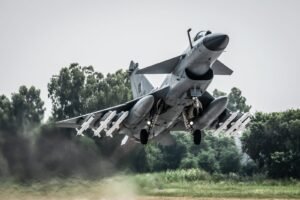
Today, Pakistan commands a formidable fleet of modern combat aircraft including JF-17 Thunder Block III, F-16 variants and the newly inducted J-10C fighters, backed by advanced munitions including long-range Air-to-Air missiles, hypersonic weapons and precision strike warheads. In the near future PAF is poised to operate multiple fifth-generation platforms including the indigenous stealth program, PFX, ushering in an era of doctrinal flexibility and stealth-enabled deterrence. Yet, numbers alone do not define dominance. PAF has invested heavily in Force Multipliers, specialized Electronic Warfare platforms, space and cyber capabilities binding Air, Ground, Naval and digital battle space into a unified Kill Chain. The integration of UAVs and UCAVs including MALE/HALE systems, loitering munitions and Manned-Unmanned teaming concepts has expanded the battlespace, enabling persistent ISR, standoff strikes and saturation of hostile defences.
Through entities such as National Aerospace Science and Technology Parks, PAF has nurtured an ecosystem where radars, EW suites, AI systems, drones and avionics are conceived, tested and fielded on Pakistani soil. NASTP has shifted Pakistan from import dependency to innovation-driven autonomy, ensuring that sanctions, embargoes or shifting allegiances cannot derail the nation’s aerospace trajectory. The green of our flag now finds tangible expression in indigenous capability, while the white symbolizes a technologically inclusive Pakistan, ready to partner but determined to stand on its own feet.
PAF’s operational maturity was visible in Operation Swift Retort, when enemy provocation was met with calibrated, precise aerial responses that restored deterrence without reckless escalation. The engagements signalled a Force that would impose heavy costs on the enemy, shape the narrative and remain professionally restrained in the face of provocation. The crucible, however, came in May 2025 when a numerically superior adversary launched its military campaign targeting innocent civilians, confident in the supposed invincibility of platforms like Rafale and S-400 Air Defence Systems, PAF faced not just aircraft, but a doctrine of coercion.
What followed has been described by international analysts as one of the longest and most intense Beyond-Visual-Range air battles of the 21st century. Engaging through a fully integrated Kill Chain, PAF J-10C and JF-17 Block III fighters networked with AEW&C platforms and supported by ground and space-based sensors, established structured dominance over the battlespace, executing Kinetic Operations that resulted in the downing of 04 x Rafales, 01 x MiG-29, 01 x Mirage 2000, 01 x Su-30MKI and a multi million dollar UAV, all without sustaining own losses. Simultaneously, the neutralization of critical components of the adversary’s S-400 system, particularly its fire-control radars, underscored the vulnerability of even advanced air defence networks when confronted with a coherent, indigenous operational architecture. The defining feature of the conflict, however, lay beyond attrition metrics, reflecting a mature application of Multi-Domain warfare in which Kinetic and Non-Kinetic effects were seamlessly synchronized across Land, Air, Space, Cyber and the Electromagnetic Spectrum. Through the integration of drones, Electronic Warfare,
AI-enabled decision support, Network-Centric Command & Control and precision strike capabilities, PAF compressed the OODA loop, achieving decision superiority and imposing operational paralysis on the adversary. Secure, indigenous C2 systems enabled real-time data fusion and centralized orchestration, ensuring Disciplined, Lawful and Precise Application of Force, ultimately demonstrating that modern warfare is decided not by numerical strength alone but by the synergy of Cognition, Integration and Strategic Resolve.
Perhaps most striking was PAF’s moral posture. Despite its ability to extend the conflict and inflict deeper damage, the PAF leadership chose calibrated responses, restoring deterrence, safeguarding sovereignty and then creating space for de-escalation. The balance between operational aggressiveness and strategic restraint is the hallmark of professional militaries and the foundation of Pakistan’s reputation as a responsible, stabilizing actor in South Asia.
On every Independence Day, when the green and white flag rises against the August sky, it does so over a Pakistan that is still tested, still contested, but increasingly sure of its guardians. Under ACM Zaheer Ahmed Baber Sidhu, Pakistan Air Force has evolved into a technologically resurgent, doctrinally sophisticated and morally anchored force that has redefined airpower in the region. Quaid’s vision of an Air Force “Second to None” is no longer a distant aspiration; it is a lived reality reflected in indigenization drives like NASTP, in a diversified aircraft & UAV fleet, in integrated Kill Chains & compressed OODA loops and in the capacity to impose strategic paralysis on a numerically superior foe across Land, Air, Space, Cyber and the Electromagnetic Spectrum. As the nation renews its pledge to the ideals of Unity, Faith and Discipline, PAF stands as the sharp edge of that pledge, a Force that will not allow an inch of Pakistan to be violated, that will continue to innovate and adapt and that will remain, in spirit and in capability, Second to None.