
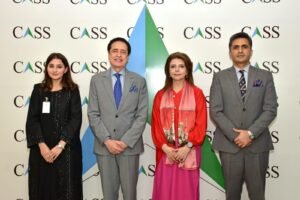
CASS Lahore roundtable highlights education gaps, weak governance and the need for long-term human capital reforms.
Lahore, October 8, 2026: The Centre for Aerospace and Security Studies (CASS), Lahore, hosted a roundtable discussion on Pakistan’s education crisis and its impact on human capital development, bringing together academics, intellectuals and experts to examine challenges facing the country’s education system.
Titled “Human Capital at Risk: Education, State Capacity and Pakistan’s Development Challenge,” the discussion was held on October 7, 2026, as part of CASS Lahore’s ongoing academic engagements on critical national, regional and international issues.
Ms Faiza Abid, Research Assistant at CASS Lahore, delivered the opening address.
Speaking at the event, Dr Soufia Anis Siddiqi, Assistant Professor at the LUMS School of Education, highlighted the scale of Pakistan’s education crisis, noting that an estimated 25–26 million children remain out of school. She also pointed to Pakistan’s Human Capital Index of 0.41 and education spending of only around 0.8 percent of GDP.
Dr Siddiqi said the country’s education challenge extends beyond access and learning outcomes. She questioned the narrow way education is often viewed primarily as an investment in human capital, arguing that its wider social purpose also needs greater attention.
She further highlighted the undervaluing of teachers and vocational education while stressing the growing importance of communication, adaptability and digital skills. According to her, Pakistan needs a broader education vision that reflects its demographic realities and changing social, economic and technological requirements.
Dr Fouzia Khan, Chief Executive Advisor at the School Education & Literacy Department, Government of Sindh, focused on the importance of effective education governance in building human capital over the long term.
She described human capital development as a continuous education pipeline involving four interconnected stages: entry, stay, progress and learn. She stressed the need for better planning, data-driven decision-making, professional teacher management, adequate resources and stronger community participation.
Dr Khan also called for education reforms to be embedded within sustainable government structures and supported by evidence-based implementation and coordinated partnerships, enabling children to acquire the knowledge and skills required to contribute meaningfully to Pakistan’s development.
In his concluding remarks, Air Marshal Asim Suleiman (Retd), President CASS Lahore, described education as a fundamental pillar of Pakistan’s human capital, social development and economic future.
He emphasised that progress requires more than increasing access to education, stressing the importance of improving learning outcomes and strengthening the institutions responsible for delivering education.
Air Marshal Asim Suleiman also drew attention to persistent disparities based on gender, geography and income, and called for stronger links between education, skills development, employment, social protection and emerging technologies.
He identified three key priorities for the way forward: improving educational outcomes, ensuring that investment translates into effective service delivery, and developing a long-term human-capital strategy supported by policy continuity and sustained institutional commitment.
The event concluded with an interactive discussion covering issues including teacher training, homeschooling, education quality, and the structural and financial constraints affecting Pakistan’s education system.
Participants appreciated CASS Lahore for facilitating a substantive discussion on the country’s education challenges and the need for long-term reforms to strengthen Pakistan’s human capital.