CASS Discusses Indigenous Aerospace Technology to Strengthen Pakistan’s Strategic Capabilities
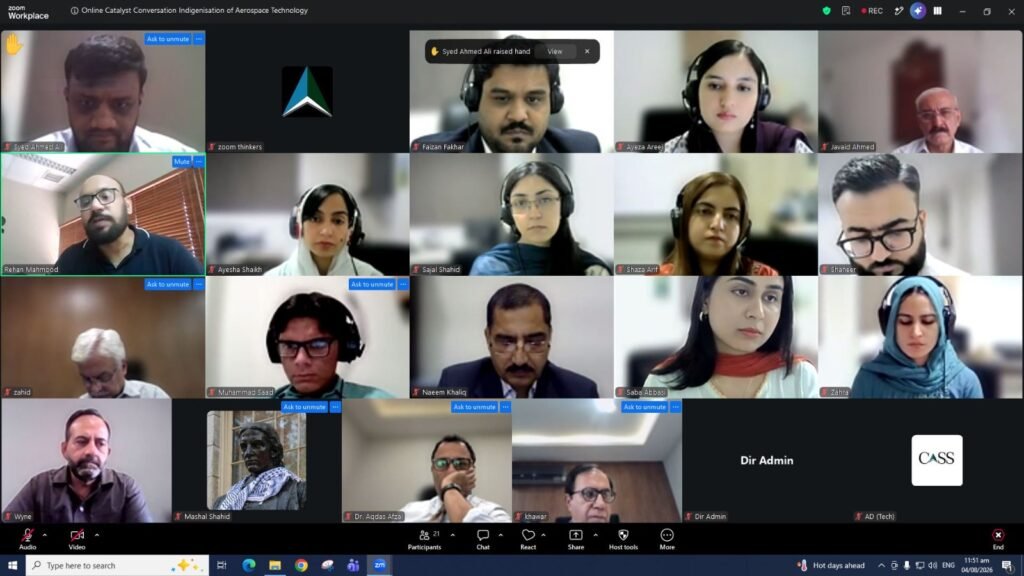
ISLAMABAD: The Centre for Aerospace & Security Studies (CASS), Islamabad, hosted an online Catalyst Conversation on “Indigenisation of Aerospace Technology” on August 4, bringing together experts to discuss the importance of building Pakistan’s indigenous aerospace capabilities amid evolving global technology restrictions and supply chain challenges.
The discussion focused on the strategic, technological, and industrial priorities required to strengthen Pakistan’s aerospace sector and reduce dependence on foreign technologies. As an independent think tank, CASS regularly organizes such forums to encourage informed debate on issues of national and international importance.
Moderating the session, Air Vice Marshal Nasser Wyne (Retd.), Director CASS, described indigenous aerospace development as a long-term national priority. He stressed that sustained investment in research and development (R&D), stronger collaboration among government institutions, academia, and industry, along with consistent policy support, are essential to creating a resilient aerospace ecosystem. He also emphasized the importance of investing in skilled human resources and following a realistic roadmap aligned with Pakistan’s strategic objectives.
Delivering the keynote address, Dr. Rehan Mahmood, Director at the Institute of Space Technology (IST) and Assistant Professor of Satellite Technology and Communication Engineering, said Pakistan has the talent, ambition, and strategic necessity to develop advanced indigenous aerospace capabilities.
He noted that the country’s primary challenge is not a lack of commitment but the need for stronger long-term R&D, reliable supplier networks, advanced testing infrastructure, and specialized product development companies. According to Dr. Mahmood, technological progress is achieved through strong institutions rather than isolated projects.
He advocated a strategy of controlled indigenisation, balancing capability development with operational readiness. He added that every procurement, technology transfer, and international partnership should contribute to measurable national learning by enabling Pakistan to repair, test, modify, document, and eventually export aerospace subsystems.
Dr. Mahmood also proposed establishing a nationwide network of specialized subsystem suppliers supported by a phased localisation strategy. Such an approach, he explained, would prioritize technologies with shorter learning cycles while maintaining a long-term roadmap for mastering more complex aerospace capabilities.
Concluding the session, Air Marshal Javaid Ahmed (Retd.), President CASS, reaffirmed that indigenous aerospace capability is critical for enhancing Pakistan’s technological resilience and strategic autonomy. He stressed that sustained institutional commitment, a coherent industrial policy, and close cooperation between the public and private sectors are vital for developing a competitive aerospace ecosystem capable of supporting both defence and civilian requirements in the future.
Table of Contents