
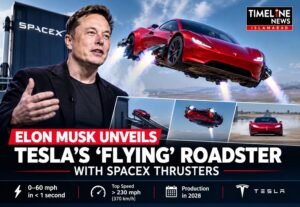
Elon Musk Tesla Flying Roadster
Tesla’s long-awaited electric sports car made headlines after a dramatic demonstration featuring rocket-style thrusters, mid-air manoeuvres and an ambitious vision for high-performance driving.
Tesla CEO Elon Musk has brought renewed attention to the future of electric sports cars after unveiling a redesigned Roadster featuring SpaceX-inspired propulsion technology. The vehicle was demonstrated at a SpaceX testing facility in Texas, where it performed a series of eye-catching stunts that included driving upside down, briefly lifting off the ground and rotating in mid-air.
The demonstration, held on October 15, 2026, showcased Tesla’s attempt to combine electric vehicle engineering with technology developed for the aerospace sector. Although the vehicle has been described as a flying car, its demonstrated ability to leave the ground does not yet make it a conventional aircraft or a practical flying vehicle for everyday travel.
Tesla Roadster Demonstrates SpaceX-Inspired Technology
One of the most striking features of the new Roadster is its thruster system, developed through collaboration between Tesla and SpaceX. The system uses bursts of compressed gas to help the vehicle perform specialised manoeuvres, including brief jumps and controlled rotations.
During the unveiling, the prototype climbed a curved ramp and travelled along an inverted section before using its thrusters to launch into the air and complete a rotation. The demonstration also showed the car jumping over a row of Tesla vehicles.
Tesla engineers also presented a suction-based system installed beneath the vehicle. The system was demonstrated as a way to hold the car against an inverted surface, while the company has discussed its potential to improve grip and stability during high-performance driving.
These features distinguish the Roadster from conventional electric sports cars, although their real-world performance, reliability and safety will need to be established beyond a promotional demonstration.
Electric Performance Remains Central to the Roadster
Despite the attention surrounding its flying capabilities, the Roadster remains an electric sports car at its core. Tesla has promoted the vehicle as a high-performance model designed to deliver rapid acceleration, high top speeds and advanced engineering.
At the unveiling, Musk highlighted an acceleration target of zero to 60 miles per hour in less than one second. Tesla has also cited a top speed exceeding 230 mph. These are extraordinary performance claims, and independent testing will be needed to establish how the production vehicle performs under real-world conditions.
The company has not yet delivered the new-generation Roadster to customers. Its final specifications, production readiness and performance across different driving conditions remain important questions for potential buyers.
Production Plans and Availability
The second-generation Roadster has been a long-running project for Tesla. First announced in 2017, the model was originally expected to arrive several years ago, but its launch has been repeatedly delayed.
Following the latest demonstration, Musk indicated that Tesla is targeting production in 2028. However, the proposed timeline should be treated as a company target rather than a guaranteed delivery date, given the project’s history of delays.
The thruster-equipped version is expected to be particularly exclusive. Reports indicate that the most advanced configuration, referred to as the Rocket version, is intended for selected customers and is not approved for use on public roads in its demonstrated flying configuration.
The cost of the vehicle and its specialised technology could also limit its appeal to a relatively small group of buyers. Final pricing, availability and regulatory requirements will be important factors as Tesla moves towards production.
Safety and Regulatory Challenges
The Roadster’s thruster technology introduces challenges that conventional electric vehicles do not face. Any vehicle capable of lifting off the ground must address stability, controlled landing, passenger protection and the risks posed to people nearby.
Regulatory approval is another major obstacle. A vehicle designed for ordinary road use must meet automotive safety standards, while flight-capable systems raise additional questions about where and how they can legally operate.
The demonstration was conducted in a controlled environment, and the flying configuration should not be interpreted as a vehicle that consumers can currently drive or fly on public roads. <Cite refs={[“turn865338search0″,”turn865338search2″,”turn865338search6”]}/>
A Technology Showcase for Tesla and SpaceX
The unveiling reflects Musk’s broader ambition to connect automotive innovation with aerospace engineering. Tesla focuses on electric vehicles, while SpaceX develops launch vehicles and spaceflight technology. The Roadster brings elements of these two fields together in an unusually ambitious product.
Beyond its potential commercial value, the car could serve as a showcase for Tesla’s engineering capabilities and reinforce its position in the high-performance electric vehicle market.
However, the vehicle’s long development timeline means that customers and industry observers will be looking for evidence of progress towards production, rather than relying solely on spectacular demonstrations.
What Comes Next for the Tesla Flying Roadster?
The redesigned Roadster has generated interest because it challenges traditional expectations of what an electric sports car can do. Its combination of electric propulsion, specialised thrusters and experimental aerodynamic features offers a glimpse of unconventional automotive engineering.
Nevertheless, questions remain about production timing, pricing, road legality and the practical usefulness of its flight-like capabilities. The proposed 2028 production target will be a key milestone, but the final production model may differ from the prototype demonstrated in Texas.
For now, the Tesla Roadster is best understood as an ambitious high-performance electric vehicle with experimental, thruster-assisted capabilities—not a widely available flying car. Its eventual success will depend on whether Tesla can turn the technology demonstrated on stage into a safe, reliable and commercially viable product.