Climate money or climate debt?
Climate Money or Climate Debt? Pakistan Urged to Demand Fair Climate Finance at COP31
Islamabad:As Pakistan prepares for COP31, it must demand more than promises of climate finance. Flood-hit families need grants, quicker relief and protection from unsustainable debt. Wealthier countries, whose emissions have driven global warming, should help pay for recovery and adaptation. Pakistan, meanwhile, must prove that every rupee received reaches vulnerable communities and produces lasting protection. That is the central choice between genuine climate justice and a greener form of debt.
Written By Mehvish Raja and Dr Shahzad Kouser[1]
[1] Mehvish Raja is a PhD scholar at COMSATS University and Senior Faculty Member at SKANS School of Accountancy. Dr Shahzad Kouser is a Tenured Professor at COMSATS University Islamabad, specializing in climate finance and related economic and policy issues.
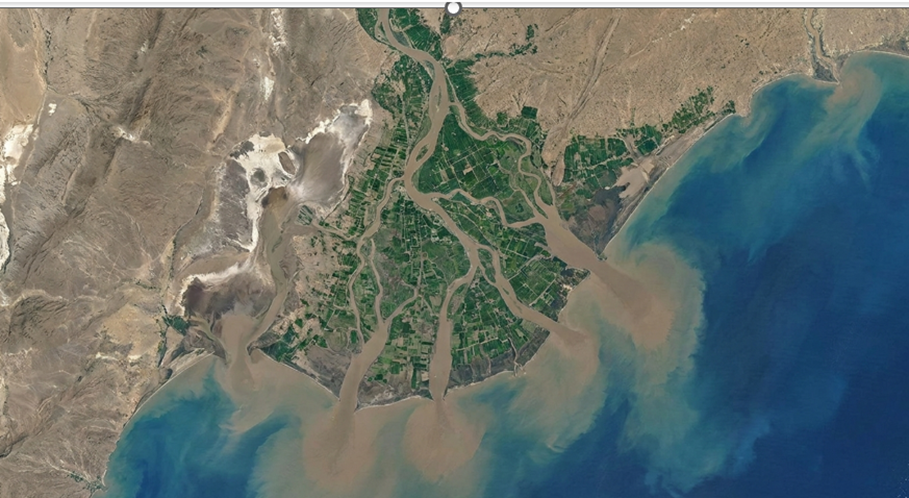
Figure 1: True-color satellite photograph of the Indus River Delta and southern coastline of Pakistan entering the Arabian Sea. Climate-driven shifts in river discharge, marine inundation, and severe weather threaten Sindh’s agricultural heartland, coastal fisheries, and millions of vulnerable livelihoods.
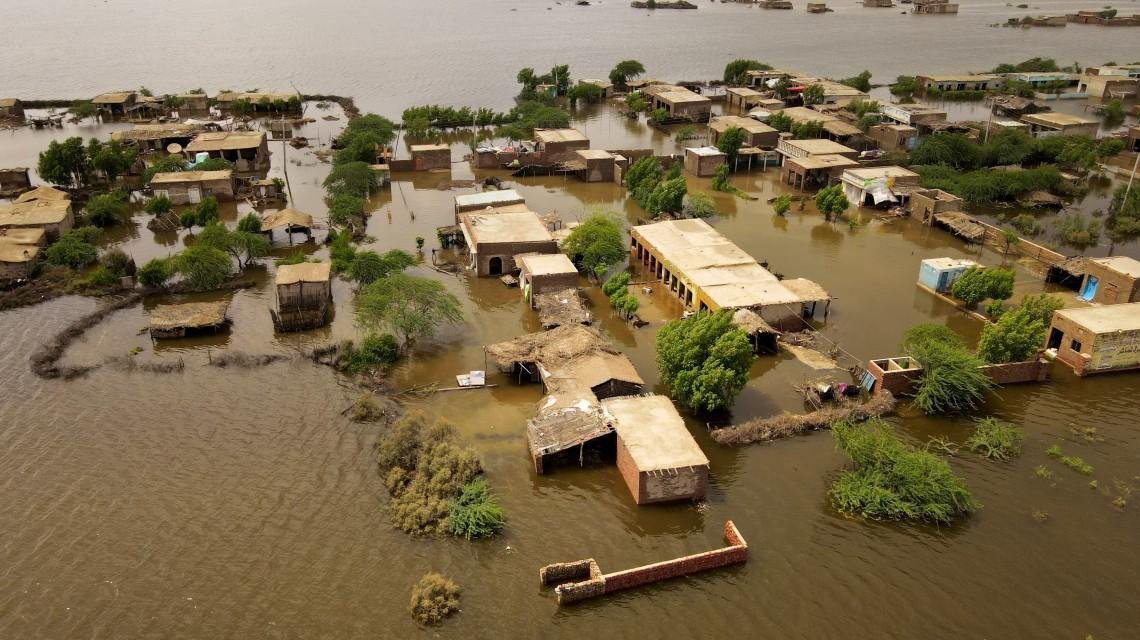
Muhammad Zahid, a farmer from southern Punjab, supported nine children through his plot, rented land and a seasonal sugarcane juice cart. The 2025 floods destroyed his crops, damaged his home and left land waterlogged. His family fell into debt, according to The Big Issue and Islamic Relief. His story shows why climate finance is about whether people can rebuild their lives, not merely diplomatic promises. Zahid did not cause this crisis. Pakistan contributes less than one per cent of global greenhouse gas emissions, yet its people pay disproportionate costs. That injustice should guide Pakistan when governments meet next month in Antalya, Türkiye, for COP31, the annual UN climate conference. Pakistan must argue not only for more money, but for money on fair and sustainable terms. The question is not just how much is pledged, but who ultimately pays the bill.
Climate finance comes in different forms. Adaptation funding helps communities prepare for floods, heatwaves and drought. Loss and damage funding helps them recover when protection fails. Both are essential. But if they arrive mainly as loans, Pakistan pays twice: through destroyed homes and livelihoods, then through interest. An indebted country cannot borrow its way out of every climate disaster.
Pakistan has asked the international loss and damage fund for $58 million to restore farms, build resilient clinics and revive fisheries. None has yet received funding. The wider shortage is stark: 176 proposals seek $2.8 billion, but only $342 million is available for the first phase. Needs are recorded carefully, while the response remains painfully small.
Adaptation finance shows a similar gap. Pakistan’s climate minister says developing countries received $26 billion in 2023, although estimated needs reach $310 billion a year. Wealthier countries have promised to triple adaptation finance by 2035, but without a clear starting point, that pledge is difficult to measure. A large percentage increase means little when the original amount is too small or unclear.
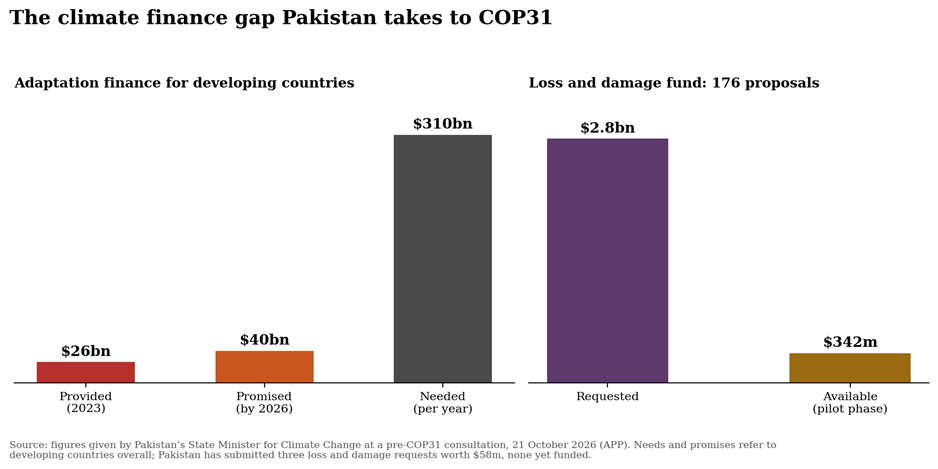
Graphic: the gap between climate finance needs and money available. Source: Pakistan’s climate minister, 21 October 2026.
The terms matter as much as the total. More than 60 per cent of Pakistan’s government revenue already goes towards debt servicing, according to the minister. Every additional repayment leaves less for schools, hospitals and disaster preparation. A “concessional” loan has a lower interest rate, but it still must be repaid, often in foreign currency, while climate losses grow.
Loans are not always wrong. They can support solar power or other projects that earn revenue and cut emissions. But flood barriers, warning systems and drought-resistant crops protect people without necessarily producing income. So does rebuilding a school or clinic. These measures need grants, not commercial lending. Survival is not a business opportunity, and climate responsibility should not be treated as one.
Pakistan should make three demands at COP31. First, adaptation and loss and damage funding must include more grants, with simple and rapid access. Second, agreements should say wealthier countries will “provide” finance, not merely “mobilise” it. Mobilisation can include private investment and loans; provision carries clearer public responsibility. Vague wording helps negotiators agree, but does little for a farmer in a flooded field.
Third, debt arrangements must reflect climate reality. Repayments should pause after major disasters, freeing money for relief and recovery. Debt swaps can convert repayments into verified local investment in resilience, but they are not magic. Their costs and benefits must be published, and they cannot replace grants. The goal is financial space to protect people, not another complex arrangement delivering little support.
Pakistan must also change how it prepares. Provinces, researchers, young people and flood-hit communities need a formal voice in its negotiating position. Their experience can identify practical priorities: safer schools, effective warnings or drainage that protects farmland. Funding should arrive before disasters where possible, not only afterwards. Preparation saves lives and money, yet receives less attention than emergency appeals.
Donors reasonably want evidence that funds are well spent. Pakistan should answer with competence. It must prepare credible projects, publish spending, audit results and ensure local institutions maintain what is built. It should also raise domestic revenue fairly. Demanding climate justice does not excuse corruption or waste. Transparent government strengthens Pakistan’s moral case and assures citizens that climate money will serve them.
COP31 will not solve Pakistan’s climat’e crisis. But it can test whether the world understands the difference between assistance and indebtedness. Zahid needs his land restored, not another repayment schedule. Every pledge faces a simple question: will it help a vulnerable family stand on safer ground without pushing Pakistan deeper into debt? If not, it is climate money in name, but climate debt in practice.
Table of Contents
Disclaimer: This article is an adapted version of an opinion piece written by Mehvish Raja and Dr Shahzad Kouser. The views and arguments expressed are those of the original authors. Financial figures, statements and projections are attributed to the sources cited in the original article. Timeline News does not claim authorship of the original research or opinions.